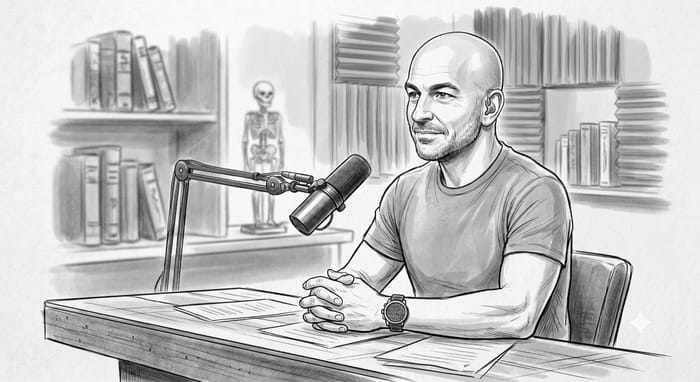
VO2 Max & the Centenarian Decathlon
Peter Attia's Centenarian Decathlon trains now for the 'marginal decade,' adding VO2 max, stability and strength work. After a zone 2 base, it adds VO2 max intervals, the top modifiable predictor since leaving the lowest fitness quartile links to a large drop in mortality risk, plus stability against falls and strength for the muscle you'll need at 90.
List the physical things you want to do at 85 to 90 Pick ~10 concrete tasks (lift a grandchild, hike, carry luggage, get off the floor); these set your training targets
Backcasting from real goals tells you exactly what to train for.
Maintain aerobic base work Roughly 3+ hours/week of zone 2 (conversational pace); see Attia's Endurance Base protocol
Zone 2 builds the mitochondrial and metabolic base everything else sits on.
Add zone 5 intervals weekly ~1x/week: hard 3 to 4 min efforts near max, equal recovery, repeated 4 to 6 times (e.g. a 4x4 protocol)
VO2 max is the highest-yield longevity marker here; intervals are how you raise it.
Lift to preserve muscle and bone 2 to 3 strength sessions/week; prioritise carries, hinges, pulls and grip
Strength and muscle mass preserve function and independence into old age.
Do deliberate stability and balance work Slow, controlled single-leg and foot/spine stability work; breathing-led control
Stability prevents the injuries and falls that derail everything else in the marginal decade.
Test and track it over time A VO2 max test at a facility, or estimate via a field test; recheck periodically
What gets measured gets trained; VO2 max is worth knowing precisely.
This protocol works from your actual levels. Testing partner coming soon.
- Heart-rate monitor
- VO2 max test
We may earn a referral fee if you book testing through a future partner link; it will never affect which tests are listed here. This is not medical advice or a diagnosis.
VO2 max and muscle mass/strength are 'integrators', they reflect years of accumulated work and track strongly with how long and how well you live.
View sources
The Drive #261: Training for the Centenarian Decathlon (Peter Attia, M.D.)
Training for the Centenarian Decathlon: zone 2, VO2 max, stability, and strength (peterattiamd.com)
Exercising for longevity: strength, stability, zone 2 and zone 5 (peterattiamd.com)
Not medical advice. This page is for education only and is not a substitute for professional medical care. Consult a qualified clinician before changing your health routine.
Independent curation. YourProtocol is an independent platform. This protocol is based on the publicly available work of Peter Attia and is not created, reviewed, endorsed by, or affiliated with Peter Attia or Early Medical / Outlive.
Is this for you
- Anyone training for a long, capable life
- People who already do zone 2 and want the next pillars
- Midlife exercisers planning ahead
- Anyone who wants to raise VO2 max
Cautions
- Zone 5 interval work is high-strain; build an aerobic base first and progress gradually
- If you have cardiovascular risk factors or are new to hard exercise, get cleared by a doctor before maximal intervals
- Stability work is not optional padding; for older trainees it is what prevents the injuries that undo the rest
- Educational only, not medical advice
Some links earn us a commission. It never affects our picks or grades. See our affiliate disclosure.