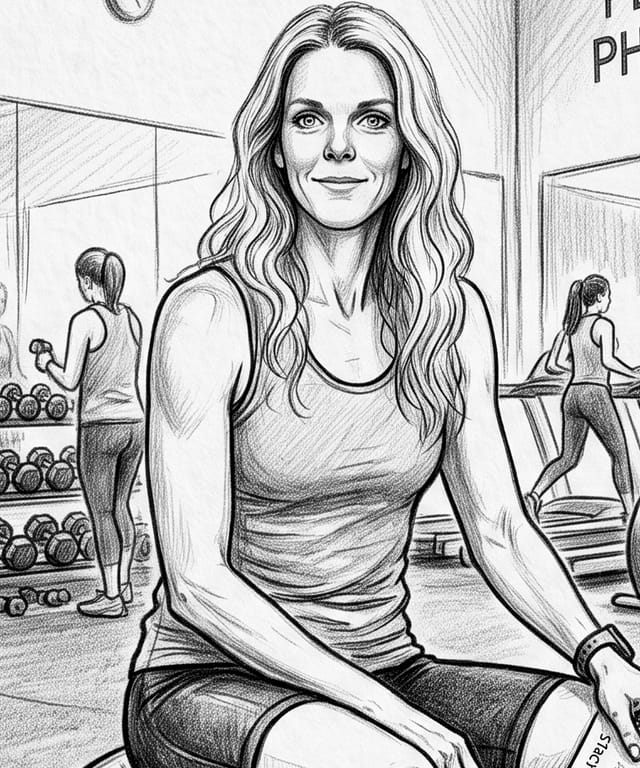
Female-Specific Training & Fueling
Stacy Sims argues women need a different playbook than default male-derived advice. Her approach favors more protein, real fueling around training rather than fasted workouts, heavy resistance work, short hard sprints instead of endless cardio, and jump training to protect bone. Women grow more anabolically resistant with age, and Sims warns under-eating, not over-eating, is the bigger risk.
Eat 1 to 1.1g protein per pound of body weight About 1.8 to 2.2 g/kg per day (toward 2.0 to 2.3 g/kg in peri/post-menopause); 30 to 40g per meal hitting roughly 3g leucine
Women get more anabolically resistant with age, so protein is what protects muscle.
Fuel before training About 15g protein pre-strength (a coffee plus protein shake works); add ~30g carbs if doing cardio up to an hour
Fasted training sends a low-energy signal in women; a little fuel protects muscle and drives the right hormonal response.
Eat within 30 to 45 minutes after training Reproductive years about 35g quality protein; perimenopausal and beyond 40 to 60g
Withholding food keeps the brain in a low-energy state, and lean mass is the first thing it gives up.
Resistance training at least 3x per week 3+ heavy sessions per week of compound lifts, about 6 to 8 reps near failure (1 to 2 in reserve); younger women can train to failure, older women should train heavy
Heavy load drives the central-nervous-system and strength response that matters most as estrogen declines.
Add sprint interval training 1 to 2 sessions per week of all-out 10 to 30 second efforts (~100 to 110 percent) with 2 to 4 min recovery; skip long moderate cardio that just spikes cortisol
True sprints drive growth hormone, body composition and metabolic health, especially in perimenopause.
Add jump / plyometric training Low-impact jumps about 3 x 10 min per week; consider a weighted vest starting around 10 percent of body weight
Estrogen decline accelerates bone loss; loading and jumping build bone density.
Take 3 to 5g creatine daily 3 to 5g per day (some use more for cognitive benefit)
Strong evidence for strength, power and brain in women, particularly peri and post-menopause.
Use electrolytes, not just water Add sodium and electrolytes around training, especially in heat
Hydration needs shift across the cycle as plasma volume changes; women are not small men here either.
Use sauna and track bone with DEXA Post-training sauna for recovery and menopausal symptom relief; a periodic DEXA scan to monitor bone density
Heat aids recovery and adaptation, and DEXA catches bone loss early enough to act.
Women become more anabolically resistant with age and respond differently to fasted training, recovery windows and intensity than men.
View sources
Dr. Stacy Sims: sprint interval training
Huberman Lab: Dr. Stacy Sims on female-specific exercise and nutrition
Training during perimenopause (Dr. Stacy Sims)
Not medical advice. This page is for education only and is not a substitute for professional medical care. Consult a qualified clinician before changing your health routine.
Independent curation. YourProtocol is an independent platform. This protocol is based on the publicly available work of Stacy Sims and is not created, reviewed, endorsed by, or affiliated with Stacy Sims or Author, ROAR & Next Level.
Is this for you
- Active women 30+ who want to stay strong
- Women in perimenopause or menopause
- Women told to just do more cardio
- Anyone under-fueling their training
Cautions
- Sims sells no supplement line of her own; she advises and recommends third-party-tested products. Treat the items here as generic recommendations and confirm specific brands before relying on them
- This protocol is about fuelling more, not restricting; under-eating (low energy availability) is the main risk Sims warns against
- Hormone therapy and menopause treatment are medical decisions for your doctor; this is education, not medical advice
- If you are pregnant, new to lifting, or managing a medical condition, build up gradually, master form first, and get individualised guidance
- Build sprint and high-intensity work up over time, and clear it with a doctor if you have cardiac risk
Some links earn us a commission. It never affects our picks or grades. See our affiliate disclosure.